A new global light pollution map of Catalonia reveals the impact of artificial light at night on human health and ecosystems. From HAUS we analyse why responsible light management is also a matter of health and environmental comfort.
This week saw the publication of the first global light pollution map of Catalonia, a scientific and technical milestone that speaks directly to us as professionals committed to environmental comfort and health in construction. The study, produced by the IEEC and the Institute of Cosmos Sciences of the University of Barcelona, was made possible through advanced modelling of over 1.5 million public light sources and a real-time sensor network distributed across the territory. The result: a precise snapshot of our night sky, with a resolution of just one square kilometre.
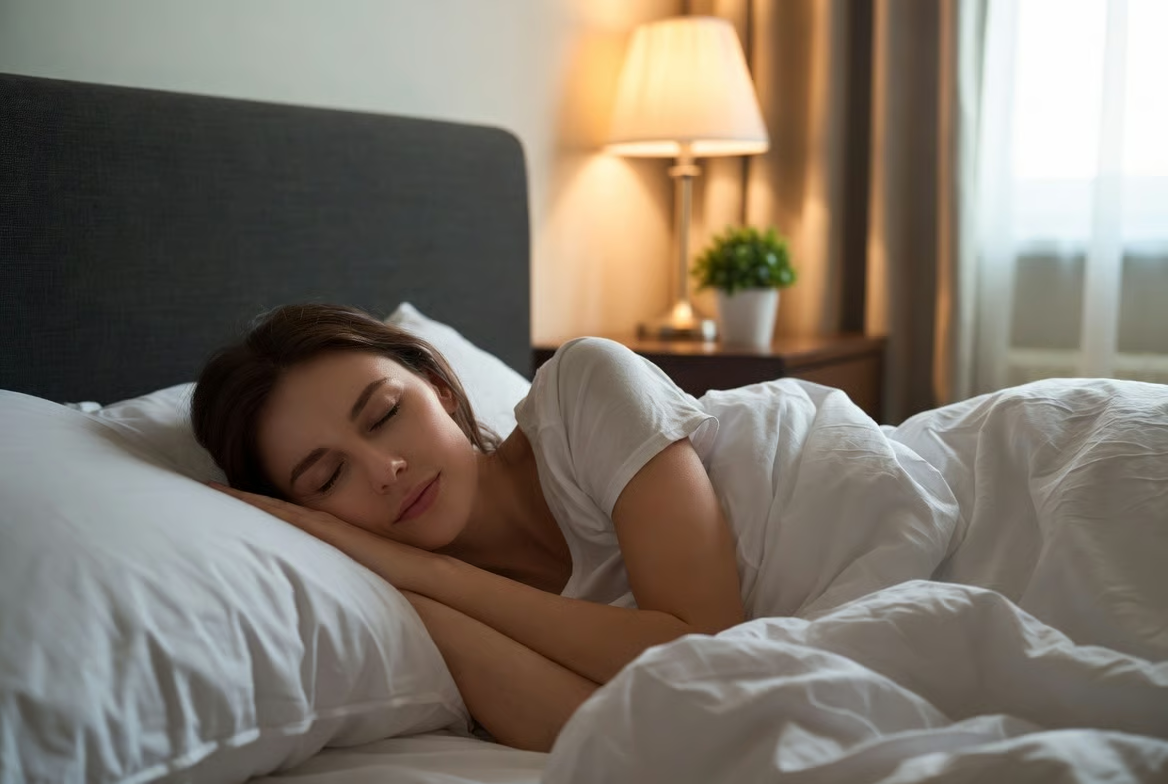
From an environmental comfort standpoint, light pollution is not merely an astronomical issue. It is a human health risk factor and a first-order vector of ecological imbalance. At HAUS we have long championed an integrated vision of comfort that includes light as one of the essential nutrients for our bodies. But it is worth noting that artificial light at night — especially light with blue-spectrum wavelengths, poorly directed, or with excessive luminance — can cause circadian rhythm disruption, difficulty falling asleep, reduced sleep quality, and cumulative effects on the endocrine and immune systems[1].
Furthermore, light pollution profoundly disrupts nocturnal ecosystems: it disorients migratory birds, affects the reproductive patterns of insects and amphibians, and alters the behaviours of many nocturnal species. The impact on biodiversity is particularly significant in fragile environments such as natural parks or agricultural areas, which should serve as true refuges of darkness.
For all these reasons, this new map is not merely an informational tool: it is a call to action. We must incorporate responsible lighting management criteria into urban design, exterior lighting, and the buildings in which we live and work. Building professionals have both the opportunity and the responsibility to prescribe solutions that minimise unnecessary light emissions: time-based regulation, intensity control, use of warm-spectrum light, directional screens, and above all, a new culture of darkness as an environmental value.
At HAUS we work to ensure that every project is a space where light contributes to well-being, rather than becoming a source of dysfunction. And this map, along with the scientific data that supports it, helps us clearly see what often goes unnoticed: that the right to nocturnal darkness is also an environmental and health right.
Carolina Hdez. Peratta
HAUS Healthy Buildings
References
- [1] Stevens, R.G. & Zhu, Y. (2015). "Electric light, particularly at night, disrupts human circadian rhythmicity: is that a problem?" Philosophical Transactions of the Royal Society B: Biological Sciences. — This review demonstrates how exposure to artificial light at night interferes with melatonin production and the natural circadian rhythm, disrupting the sleep-wake cycle.
- ▪ Walker, W.H. et al. (2020). "Circadian rhythm disruption and mental health." Translational Psychiatry, 10, 28. — Shows how circadian rhythm disruption can contribute to insomnia, mood disorders and anxiety.
- ▪ Cho, Y. et al. (2015). "Effects of artificial light at night on human health: A literature review of observational and experimental studies." Chronobiology International. — An extensive review concluding that exposure to nocturnal light reduces sleep quality, increases the time needed to fall asleep, and causes nighttime awakenings.
- ▪ Bedrosian, T.A. & Nelson, R.J. (2013). "Influence of the modern light environment on mood." Molecular Psychiatry. — Shows how artificial light at night can affect the production of hormones such as cortisol and melatonin, with effects on the endocrine system and inflammatory responses.
- ▪ Fonken, L.K. et al. (2013). "Dim light at night disrupts molecular circadian rhythms and increases body weight." Journal of Biological Rhythms. — Provides experimental evidence that nocturnal light can dysregulate hormonal systems and promote metabolic and immune imbalances.
Topics